Last updated on August 23rd, 2026
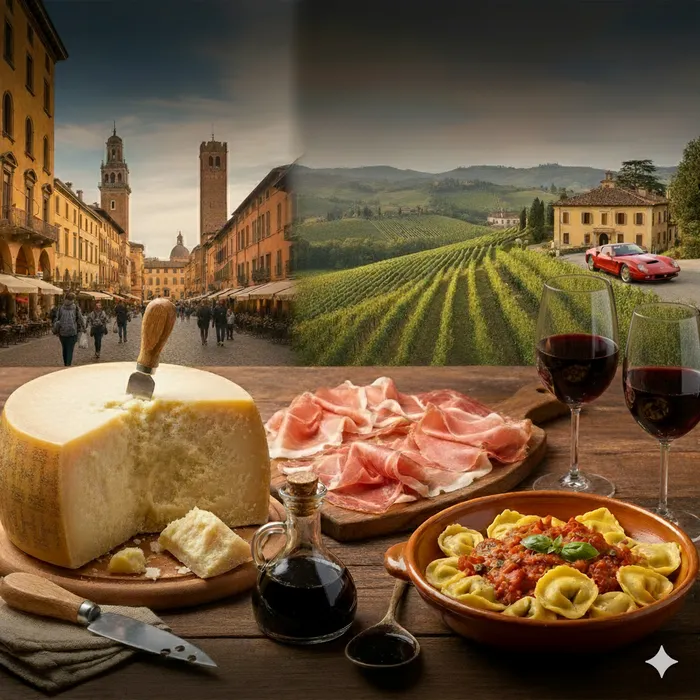
There is a specific quality to the air in Emilia-Romagna, Italy’s acclaimed “Food Valley.” It is a region where the fog that rolls off the Po River seems to carry the scent of aging prosciutto and roasting chestnuts. For the luxury traveler, a trip to cities like Bologna, Parma, or Modena is rarely just about sightseeing; it is a pilgrimage of the palate.
However, the true luxury of travel isn’t always about where you go, but what you bring back. We often fill our suitcases with souvenirs, but the most enduring mementos are culinary. In an era of fast fashion and even faster food, curating a kitchen pantry based on heritage, authenticity, and slow craftsmanship is the ultimate act of modern sophistication.
Bringing the taste of Emilia-Romagna into your home is not about replicating a restaurant menu; it is about understanding the philosophy of the region. It is about recognizing that time, patience, and terroir are ingredients that cannot be synthesized. Here is why authentic Italian heritage matters on your plate and how to distinguish the exquisite from the ordinary.
The Art of “Slow Food” in a Fast World
In the United States, we are often accustomed to convenience. We want ingredients that are ready now, available in every season, and uniform in taste. The philosophy of Emilia-Romagna is the antithesis of this. Here, food is dictated by the rhythm of nature and the heavy hand of tradition.
The concept of “Slow Food,” which has roots deep in Italian culture, suggests that eating is an agricultural act and a cultural exchange. When you sit down to a dinner prepared with heritage ingredients, you are participating in a lineage that spans centuries.
The Importance of Provenance
For the discerning epicurean, the label on a bottle or a package is more than just branding; it is a map. In Europe, and specifically in Italy, systems like PDO (Protected Designation of Origin) and PGI (Protected Geographical Indication) are strictly enforced. These are not marketing gimmicks. They are legal guarantees that a product was produced in a specific region using traditional methods.
Why does this matter for your Tuesday night dinner or your Saturday cocktail party? Because “parmesan” made in a factory in Wisconsin simply does not possess the crystallised texture or the nutty complexity of a wheel of Parmigiano Reggiano that has been aged for 24 months in the humid microclimate of Parma. The terroir—the soil, the air, the bacteria native to the region—imparts flavor profiles that are impossible to duplicate elsewhere.
The Liquid Gold of Modena
Perhaps no product better exemplifies the intersection of history, patience, and luxury than the traditional condiments of Modena. While the region is famous for sleek supercars like Ferrari and Maserati, its most precious export is slow, dark, and incredibly complex.
Walking through an ancient acetaia (vinegar loft) in Modena is a spiritual experience. You are surrounded by batteries of wooden barrels—oak, chestnut, cherry, juniper, and mulberry—each decreasing in size. Inside these barrels, cooked grape must is undergoing a transformation that takes not just years, but decades.
The result is a condiment that defies simple categorization. It is not merely sour; it is a symphony of sweet and acidic notes, with a velvety viscosity that coats the palate. When you source authentic balsamic vinegar of Modena, you are securing a product that has been decanted and refilled with meticulous care, absorbing the aromatic essences of the ancient woods. It is a product that elevates the simplest ingredients into a gourmet experience.
Recognizing Quality
When curating your pantry, look past the industrial imitations found in generic supermarkets. True Modenese heritage is found in the density and the balance of the liquid. A high-quality product should not contain caramel coloring or unnecessary thickeners. It should be pure grape must and wine vinegar, aged to perfection.
- Look for the seal: Authentic products will carry the PGI or PDO seal.
- Check the density: Pour a drop on a plate; it should hold its shape, not run like water.
- Read the ingredients: The list should be short. Grapes and time are the primary components.
Curating the Ultimate Italian Pantry
To truly embrace the lifestyle of Emilia-Romagna at home, one must move beyond the mindset of “grocery shopping” and embrace “curating.” Just as you would curate art for your walls or pieces for your wardrobe, the ingredients in your kitchen define your culinary identity.
Parmigiano Reggiano: The King of Cheeses
Often grated over pasta as an afterthought in American households, authentic Parmigiano Reggiano is a standalone masterpiece. Produced only in specific provinces, the cows are fed a strict diet of local forage. The result is a cheese that evolves from milky and soft to crumbly and savory as it ages.
- Serving Tip: Break it into rough chunks and serve with a drop of honey or a few drops of aged balsamic for an aperitivo that requires zero cooking but offers maximum impact.
Prosciutto di Parma: Sweetness and Salt
The curing of pork legs in the hills around Parma is aided by the Marino, a breeze that blows in from the sea, crossing the olive groves and pine trees before reaching the curing rooms. This unique airflow gives Prosciutto di Parma its distinctively sweet flavor and buttery texture.
- Serving Tip: Serve paper-thin slices at room temperature. Cold prosciutto loses its nuance. Wrap it around a slice of melon or simply enjoy it with a glass of Lambrusco.
Mortadella Bologna: The Misunderstood Delicacy
Forget the “bologna” of school lunches. Authentic Mortadella Bologna IGP is a silky, aromatic sausage spiced with pistachios and black pepper. It is heat-treated, making it safe and incredibly flavorful.
- Serving Tip: Cube it and serve with sourdough bread, or slice it thin to drape over warm focaccia.
Bringing the Experience to the Table
The beauty of Italian luxury food lies in its simplicity. When the raw materials are of such high heritage and quality, the chef’s ego must take a backseat. The goal is not to mask the flavors with heavy sauces or over-complicated techniques, but to highlight them.
Imagine a dinner party where the conversation flows as easily as the wine. The table is set with linen, and the food is served family-style.
- The Appetizer: A board of 30-month aged Parmigiano Reggiano, Prosciutto di Parma, and olives.
- The Primi: Fresh egg pasta, perhaps tagliatelle, dressed simply with butter or a slow-cooked ragù.
- The Finish: A vanilla gelato or a bowl of fresh strawberries.
Here is where the magic happens. By taking that bottle of Modenese heritage you have acquired and drizzling a small amount over the strawberries or the gelato, you transform a basic dessert into a complex interplay of acidity and sweetness. It is a trick used by the finest chefs in the world, yet it requires no cooking skill—only the discernment to buy the right product.
Investing in Taste
We live in a time where we are constantly encouraged to upgrade our phones, our cars, and our wardrobes. Yet, we often neglect the upgrade that affects our daily well-being the most: our food.
Choosing to buy authentic products from Emilia-Romagna is an investment in heritage. It supports the families who have tended to the grapevines and the dairy herds for generations. It preserves a landscape that is under threat from industrialization.
But most selfishly, and perhaps most importantly, it ensures that every meal you eat is an experience rather than a chore. It brings the romance of the Italian countryside—the fog, the history, the passion—right to your dining table. In a world that moves too fast, taking the time to savor the authentic taste of history is the ultimate luxury.