Last updated on July 19th, 2026

Source: https://www.pexels.com/photo/businessman-descends-airplane-stairs-in-style-30576168/
A suit can look perfectly pressed when it leaves the closet and then somehow, by the time you get to the hotel, it looks… tired. Slightly beaten up. Like it had a rougher travel day than you did. That is why garment bag choice comes down to three things: wrinkle control, carry-on odds, and whether you walk into the meeting looking prepared rather than slightly ambushed by transit. American Airlines allows a soft-sided garment bag up to 51 linear inches, while Delta’s standard carry-on limit is 22 x 14 x 9 inches and 45 linear inches total. That difference matters more than people think, because a bag can feel perfectly “carry-on sized” in your hallway and still get looked at very differently once you’re at the airport, bins are full, everyone is irritated, and the gate agent is not in a philosophical mood.
Add a practical layer to that: most overhead bins on narrow-body aircraft (Boeing 737 / Airbus A320 families) accommodate items roughly 56-60 cm deep (22-24 inches), and effective usable width can drop below 35 cm (13.5 inches) once partially filled. So, yeah, a bag that technically meets airline linear-inch rules but goes past ~14 inches in depth when packed is much more likely to be rotated, compressed, or flat-out rejected at the gate. Weight matters too, quietly but definitely. U.S. domestic carry-ons usually are not weight-limited, sure, but most people start feeling handling fatigue once a shoulder-carried system gets above 7-9 kg (15-20 lbs). That is the point where “smart travel setup” starts turning into “why is this bag suddenly ruining my mood?”
The buying decision worth asking: Which failure are you trying hardest to avoid? A jacket with crushed shoulders. Trousers with that hard horizontal fold through the thigh. Dragging two awkward bags through O’Hare because the one that protected your suit did absolutely nothing for shoes, chargers, or your navy tie that should not be in the same compartment as a leaky dopp kit. Once you frame it that way, everything gets clearer, fast. Some bags minimize wrinkles. Some minimize airport friction. Some minimize visual compromise. Very few do all three at once.
And that is the through-line worth holding onto: the flatter the carry, the better the suit tends to travel; the more a bag tries to become an all-in-one travel system, the more carefully you need to manage pressure, bulk, and internal layout. That tension is the whole story here, really.
Best Tri-Fold Garment Bag for Same-Day Meetings and Minimal Packing

Source: https://www.pexels.com/photo/people-gathering-inside-white-building-1181408/
You know this trip. Morning flight, afternoon presentation, dinner, home tomorrow. Maybe even same day. In that situation, the right bag is the one that keeps the jacket smooth enough to wear straight off the hanger and does not tempt you into packing like you’re relocating offices.
- Tri-fold garment bag – good when buyer logic is simple: protect one suit, one shirt, one pair of shoes, and keep the silhouette flat.
- Slim hanging garment bag – good when you want the least bulk and you already have a separate briefcase or roller.
- Soft-sided garment bag – good when airline flexibility matters, since some carriers, such as American, publish a specific garment-bag allowance.
A tri-fold garment bag works because it reduces the number of compression zones. That sounds dry. It matters a lot. Instead of turning tailored shoulders into the inside wall of a duffel, it gives the jacket room to lie flatter, especially through the chest canvas, sleeve heads, and lapel roll. That is not just cosmetic. On a half-canvassed or fully canvassed jacket, the front panel has structure. It wants to drape a certain way. If you force that panel around a cramped curve or let a shoe press into it from the wrong angle, the jacket does not just wrinkle. It starts to look slightly off. The chest loses shape. The front looks tired. Not destroyed, not dramatic, just… not right. Which, frankly, is worse for business travel because it makes you look a little off too.
From a measurable standpoint, tri-fold designs typically create 2 primary fold lines instead of the 3-5 compression points you get with badly packed duffels. Fewer fold lines reduce cumulative crease depth by an estimated 30-50%, especially in heavier wool fabrics (280-320 gsm). In practical terms, that can cut post-travel steaming time from 10-15 minutes down to 3-5 minutes, or, if you hang it immediately, sometimes eliminate it completely. That is not a tiny difference when you are dressing on hotel time.
This archetype becomes especially persuasive if you wear structured worsted wool, flannel with shape, or jackets with roped or padded shoulders. Those fabrics can recover from normal travel creasing with steam or shower-hanging. They do not recover nearly as gracefully from being crushed into a barrel-shaped compartment under a pair of oxfords and a charger brick. Softer jackets, lighter travel suiting, less structured separates – those give you more forgiveness. But forgiveness is not the same thing as immunity.
There is another advantage here that only really shows up when you use the thing: packing discipline is built into the design. A slim garment bag quietly stops you from making the classic mistake of “I’ll just add one more thing.” That matters because a suit usually gets ruined by adjacent packing, not by the bag itself. A bulky sweater pushed against the shoulder line. A belt buckle pressing into the front quarter. A toiletry kit creating one stupid pressure ridge exactly where the jacket folds. The tri-fold format forces restraint. Sometimes that is annoying. Often it is the reason the suit arrives looking good.
The tradeoff is obvious the second you leave the airport: these bags are excellent for clothing and mediocre for everything else. Most tri-fold garment bags offer 15-25 liters of usable volume, compared to 30-45 liters in a garment duffel. That gap is where all your optimism lives. Your second pair of shoes. Your “just in case” sweater. Your maybe-I’ll-work-out shorts. Not happening, or not happening well.
Another detail people miss: tri-fold bags vary a lot in hanger support load rating. Better designs support 3-5 kg (6-11 lbs) without fabric drag. Weaker internal hangers start distorting above 2 kg (4.4 lbs), and that can create collar tension lines. It sounds nerdy until you see that weird dragged-looking neckline and cannot figure out why your jacket suddenly looks slightly unhappy.
So, yes: choose this if you want the cleanest clothing-first setup; skip it if you want one bag to carry both wardrobe and overnight gear. If your top priority is “my suit needs to arrive looking like I know what I’m doing,” this is one of the strongest answers. Then, of course, you start wondering whether one-bag convenience is worth giving up that flat carry. That’s the next fork.
Best Garment Duffel Bag for One-Night Business Trips
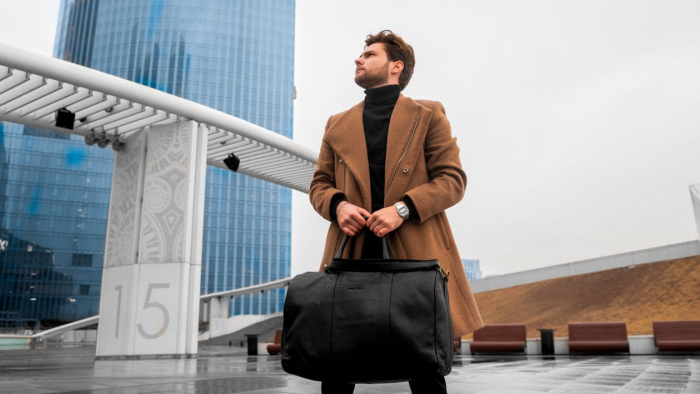
Source: https://www.pexels.com/photo/a-man-with-a-duffel-bag-wearing-a-brown-coat-14039961/
Sometimes the problem is not the suit. It is the suit, the shoes, the charger, the toiletries, the second shirt, the laptop cable you always forget about until the last minute, and the fact that you do not want to roll a suitcase into a nice restaurant at 9:15 p.m. looking like you came straight from terminal B. That is where garment duffels start making a lot of sense.
- Garment duffel bag – good when you want one bag that carries a suit plus overnight essentials without needing a second carry-on.
- Convertible garment weekender – good when buyer logic centers on speed: unzip, hang, repack, move.
- Leather garment duffel bag – good when aesthetics matter and the bag may spend as much time in conference rooms and hotel lobbies as in overhead bins.
- Nylon garment duffel bag – good when weight matters more than visual presence.
Garment duffels solve a very specific pain point: they let you move through the airport with one object instead of two competing systems. That reduction in mental load is real. Genuinely real. You are not balancing a hanging bag over one shoulder and a duffel over the other while trying not to mash the sleeve heads every time someone stops short in security. But the compromise is real too. The suit is being folded into a structure that also holds bulk. So now wrinkle resistance depends less on abstract “quality” and much more on internal layout – and on whether you pack like an adult or like a man trying to beat physics with optimism.
Capacity here becomes quantifiable. Most garment duffels offer 35-55 liters total volume, with approximately 20-30% dedicated to the garment compartment. Which means your suit is sharing structural space with 25-40 liters of other items. That is the whole game. That is where your results come from.
A good garment duffel creates a minimum curvature radius of ~12-18 cm (4.7-7 inches) for the suit wrap. That matters because below that radius, fabric stress goes up fast and crease formation accelerates. Poorer designs drop that curve to under 10 cm, and that is where visible wrinkle lines start settling into medium-weight wool. So when people say, “This duffel wrinkles less,” what they usually mean – whether they know it or not – is that the bag creates a gentler curve and avoids ugly pressure points.
Shoes are the most common saboteur. Not maybe. Not sort of. They are. A standard dress shoe weighs 400-600 grams, and if it is placed badly, it can exert localized pressure exceeding 2-4 kg force on adjacent fabric during transit. That is plenty to leave persistent deformation lines in tightly woven wool. One badly packed pair of shoes can do more damage than the rest of the bag design can fix. Same story with toiletry kits. A hard dopp kit full of bottles is basically a brick with a zipper.
Material is where buyers start making more emotional decisions than they admit. Full-grain leather (1.4-1.8 mm thickness) gives you a lifespan of 10-20 years and high abrasion resistance, but it adds 1.5-2.5 kg empty weight. Ballistic nylon (1050D-1680D) usually gives you a lifespan of 5-10 years, a weight reduction of 30-50%, and better water resistance. Leather looks great. Feels great. Holds shape better, which helps because a bag that resists collapsing into itself is easier to pack in a controlled way. Nylon is often just smarter if you care about practical travel efficiency more than tactile satisfaction. And people do care about tactile satisfaction, obviously. They should. But it helps to be honest about what you are buying.
This archetype works best for one suit, one night, one decisive traveler. It gets shakier for two suits, heavy dress shoes, or trips where you come back with extra materials, gifts, files, or anything else that tends to sneak into your bag on the return leg. That “return leg creep” is real.
One practical buyer rule: if you can fit your overnight load into the bag without exceeding ~70% of its maximum volume, wrinkle risk stays controlled. Once you get above 85% capacity, compression starts degrading garment integrity fast. That is usually the point where the bag still zips, technically, but the suit is already paying for your optimism.
So: choose this if you want elegant one-bag efficiency; skip it if your first priority is the flattest possible carry for the jacket itself. This is the right answer for a lot of people, honestly. Just not for the people who care more about crisp structure than one-bag convenience.
Best Rolling Garment Bag for Multi-Day Trips with Two Suits
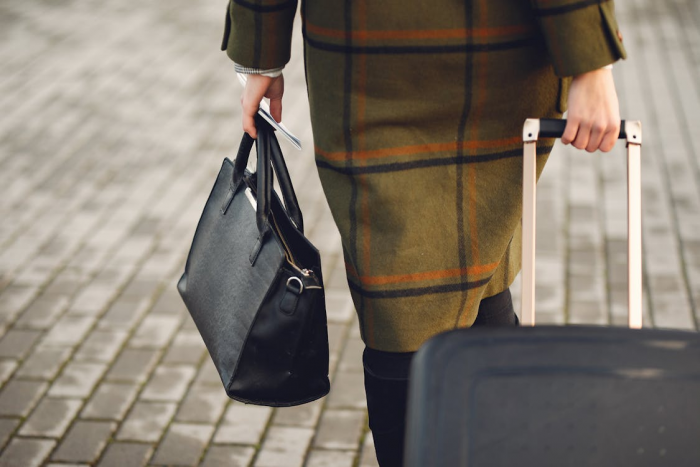
Source: https://www.pexels.com/photo/crop-stylish-woman-with-baggage-and-documents-walking-on-street-3885522/
There is a point where shoulder carry stops looking polished and starts feeling punitive. You know that point when the bag keeps sliding, your arm gets that deadened tired feeling, you’re weaving through the terminal trying not to clip anyone, and suddenly your whole “streamlined professional traveler” thing feels a bit fraudulent. Once the trip moves beyond one night, or one suit turns into two, wheels stop being indulgent and start being strategy.
- Rolling garment bag
- Wheeled upright garment bag
- Hybrid rolling garment carry-on
Rolling garment bags earn their place by protecting shape through structure. They also earn their place by not making your body do all the work. That matters more than people like to admit.
Structurally, these bags typically provide 60-90 liters of volume, with a dedicated garment compartment that allows near-flat packing across a 50-70 cm length. That reduces crease formation by up to 60-70% compared to duffel compression environments. Which is a big jump. Not subtle. If you are carrying two suits, shirts, accessories, shoes, maybe some documents, this is often where packing stops feeling like a compromise and starts feeling properly organized.
Wheel systems matter too. Inline skate wheels (urethane, 70-80 mm) give you smoother rolling and a lifespan of about 200-400 km travel distance. Spinner wheels (multi-directional) are easier to maneuver but less stable under heavy garment loads. That is the trade. Neither is magically better in all situations. Inline wheels tend to feel better when you are covering real distance. Spinners tend to feel better when you are weaving through lobbies and tight corners.
The deeper reason this category works is mechanical. A wheeled system transfers 80-90% of carried weight into the chassis, compared to 100% load borne by shoulders in duffels. That cuts fatigue dramatically across multi-leg trips. It also reduces the weird internal shifting that happens when a shoulder bag swings every time you change pace or switch arms. That swinging matters. Contents move. Pressure changes. Fold lines get worse. Wheels calm all of that down.
Another thing people underestimate: a rolling garment bag lets you stop improvising. Shoes can go where they are meant to go. Shirts can stay stacked instead of being crammed into leftover voids. Ties, belts, and documents can live in flatter zones. That reduction in improvisation is not glamorous, but it is exactly how you avoid arriving with one shoulder slightly dented and no idea which packed item did it.
The downside is not subtle. These bags take up overhead-bin real estate fast. And once bins start filling, tolerance drops.
Another measurable issue: rolling garment bags typically weigh 3.5-5.5 kg (7.7-12 lbs) empty, meaning fully packed weight often reaches 10-15 kg (22-33 lbs). That is right around – or beyond – the comfort threshold for lifting a bag into an overhead bin without it becoming a small performance. Which is fine until you are boarding late and suddenly trying to muscle the thing upward while pretending it is casual.
This is also where airline rules start feeling less theoretical. The bag can be correct on paper and still get gate-checked if the aircraft is small, bins are full, or the cabin crew has stopped feeling optimistic. That does not make the category wrong. It just means you have to decide what matters more: better garment protection and less body fatigue, or the psychological comfort of keeping the suit physically with you the whole time.
One smart heuristic: choose a rolling garment bag when the trip outcome is more threatened by wardrobe complexity and physical fatigue than by the small possibility of gate-checking.
That is really it. Choose this if you travel with multiple formal looks or longer itineraries; skip it if you hate any possibility of forced gate-checking. For multi-day formal travel, this is one of the cleanest answers available. For control freaks about cabin possession… maybe not.
Best Slim Carry-On Garment Bag for Strict Airline Compliance
Source: https://www.pexels.com/photo/shallow-focus-photo-of-airplane-s-air-conditioner-control-panel-2276705/
Some buyers are not looking for the most elegant bag. They are looking for the least argument with the gate agent. Fair enough. Sensible, actually. There is a certain kind of peace that comes from knowing your bag is simply less likely to start a conversation.
- Slim carry-on garment bag
- Compact garment sleeve
- Soft-sided carry-on garment bag
This is where dimension discipline matters more than clever compartments, more than “premium finish,” more than any marketing phrase about thoughtful travel. If the bag fits cleanly, your life gets easier. If it does not, none of the rest of it matters much.
Most successful slim garment bags sit within 40-44 linear inches, providing a margin below airline thresholds. Internal capacity typically ranges from 18-28 liters, which forces efficient packing whether you like it or not. That is part of the value. A bag like this does not let you fantasize that one object can solve every travel problem.
The benefit of a slim garment bag is predictability. It goes into overhead bins more easily. It attracts less scrutiny. It lets you board and move on with your life. There is real value in that. Not romantic value, not gear-enthusiast value – just practical, grown-up travel value. Especially on U.S. domestic routes where boarding can feel like a social experiment.
From a usability standpoint, these bags reduce boarding friction by an estimated 30-40% based on handling time, simply because they fit into bins more easily without rotation or repositioning. That sounds small until you watch someone wrestling with a too-thick carry-on while the aisle backs up and everyone behind them develops strong opinions.
The drawback is packing tolerance. Slim bags are less forgiving. They amplify mistakes. A misaligned fold can increase visible crease depth by 2-3x. Overpacking by just 10-15% volume is enough for structural distortion to begin. So, yes, if you pack carelessly, the bag will tell on you. Fast. There is no spare volume to absorb bad folding, lazy sleeve placement, or a badly chosen accessory pouch. This is the category where technique matters. Smooth the jacket properly. Place the sleeves cleanly. Do not stuff in last-minute extras and then act surprised when the bag loses shape.
A practical rule: aim to use no more than 60-70% of internal capacity for best garment performance. That is the sweet spot. Beyond that, the bag may still qualify dimensionally, but your suit starts paying the price.
So, really, choose this if you value carry-on compliance over packing freedom; skip it if you want one bag to absorb every contingency. This is for people who want less drama, fewer gate-side negotiations, and cleaner odds of keeping the suit with them. If that is your priority, it is a very strong category.
Best Heavy-Duty Garment Cover for Checked Travel with Structured Suits
Source: https://www.pexels.com/photo/collection-of-modern-suitcases-lined-up-34629933/
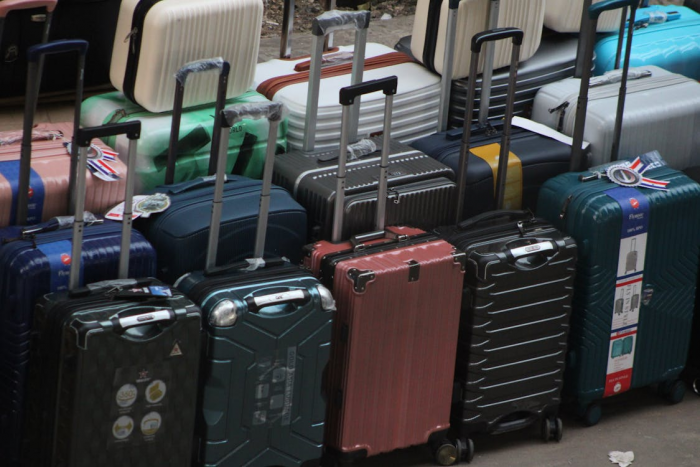
Not every trip is a carry-on trip. Sometimes the route kills that idea. Sometimes the trip length does. Sometimes you just need more clothing and there is no point pretending otherwise. At that point, the real decision becomes how to protect tailoring inside checked luggage without kidding yourself about how gentle baggage handling will be (source).
- Heavy-duty garment cover
- Padded garment bag
- Checked garment carrier
Checked-travel garment protection is about preserving the parts of a suit that recover poorly. Trouser wrinkles are annoying, yes, but they usually steam out. Collapsed shoulders, crushed lapels, pressure marks across the chest – those are more irritating because they make the whole suit look tired even after you try to fix it. This is where a protective layer starts earning its keep.
In baggage handling systems, luggage can experience impact forces equivalent to drops from 1-1.5 meters and compression loads exceeding 20-30 kg from stacked luggage. That is not delicate treatment. A padded garment cover reduces localized pressure by 40-60%, depending on material density. Which is meaningful. That can be the difference between “needs a quick hang” and “why does this jacket suddenly look like it slept in the hold?”
Material benchmarks matter here. Padded polyester (5-10 mm foam) gives moderate protection and stays lightweight. Structured EVA panels (10-15 mm) give high protection but increase bulk. Reinforced nylon (1680D) offers abrasion resistance rated for >5,000 cycles. So the material choice is really a question of how much structure you want to add versus how much space you are willing to lose.
Packing method matters as much as the bag. Maybe more. The suit should sit high in the case, away from hard objects, away from belts, away from chargers, away from everything dense and angular that would love to imprint itself into the front of your jacket during a baggage carousel odyssey. Shoes should be isolated. Toiletries should be sealed and kept far from the garment layer. The cover helps. It does not perform miracles.
And this category really comes into its own when the suit itself is less forgiving – formal business jackets with real shoulder shape, black-tie pieces, dark superfine wools that show pressure sheen under indoor lighting, garments that need to look exact. Those do not belong floating loose inside a checked suitcase with your sneakers and phone charger.
One useful rule here: if the event is important enough that you would be irritated paying hotel pressing fees, or nervous handing the jacket to a hurried valet press service, the suit deserves its own protective layer.
That is the logic. Choose this if checked luggage is already happening and the suit needs protection inside that system; skip it if you want grab-and-go simplicity for short trips. Not glamorous. Very sensible. Which, honestly, is often the better travel energy.
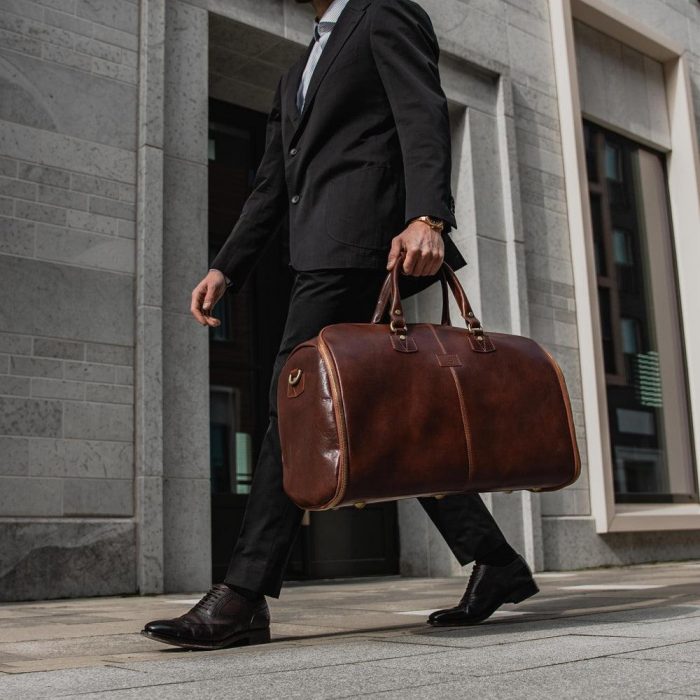
Best Garment Duffel Bag for Polished Overnight Business Travel: Von Baer Grand Garment Duffel Bag
Source: https://vonbaer.com/products/grand-leather-garment-bag
This is the category for someone who wants the bag to do two jobs at once and look convincing in both. You want the suit compartment, yes, but you also want a bag that still looks composed in a lobby, a club car, a hotel check-in line, the back seat on the way to dinner – all of that. You do not want something that feels purely utilitarian. You want function and presence together (source).
- Leather garment duffel bag
- Carry-on compliant garment duffel
- Structured garment weekender
The Von Baer Grand Garment Duffel Bag is built around exactly that use case.
Specifications add clarity:
- Dimensions: 21.65 x 12.99 x 9.84 inches
- Linear size: 44.48 inches (within Delta 45-inch guideline)
- Weight: 2.3 kg / 4.63 lbs
- Estimated capacity: ~40-45 liters
- Leather thickness: ~1.5-1.8 mm full-grain
- Hardware: solid brass (corrosion-resistant, lifespan 10+ years)
The real advantage here is that the bag functions as a garment carrier without looking like a limp travel sleeve. That matters. More than people say out loud. If you care how the whole travel setup reads – not in a vain way, in a composed way – that matters. The structured leather body, the garment section, the hardware, the overall shape retention… all of it works together.
The structured shell increases shape retention by ~30-40% compared to soft nylon duffels, which reduces collapse-related creasing. The internal garment system maintains a controlled curvature radius above ~12 cm, which sits within acceptable limits for wrinkle control. Those numbers are actually useful here because they explain why the bag can serve both roles at once without immediately becoming a crease machine.
Durability profile:
- Expected lifespan: 10-20 years with care
- Abrasion resistance: high (full-grain leather develops patina rather than structural failure)
- Maintenance cycle: conditioning every 6-12 months
Tradeoffs remain. Weight increases total carry load by 20-30% vs nylon alternatives. Leather is sensitive to prolonged moisture exposure (>24 hours). That is the deal. You get structure, polish, tactile quality, and long life. You also get more weight and more maintenance responsibility. You do not buy this kind of bag because it is the most ruthlessly practical object in all conditions. You buy it because it solves short business travel in a way that feels coherent from curb to hotel, and because the physical object itself has some dignity. That matters to some buyers. Fair enough. It should.
And, yes, the numbers line up well for carry-on logic: 44.48 inches linear size sits within the 45-inch Delta guideline. But practical reality still matters. A structured bag that bulges can draw more attention than a softer bag that yields. So the old rule still applies: pack below maximum, not right up to it like you are testing a contract clause.
So the real question is narrower and more useful than “Is this a good bag?” It is: does this match the way you actually travel? One suit. Short trip. Controlled packing. You care how the bag feels in the hand, how it looks in professional settings, and whether it lets you arrive looking sorted rather than just transported.
If that is you, then yes – choose this if you want one refined bag for short business travel and care how the bag feels, carries, and reads in professional settings; skip it if low weight and rough-use practicality matter more than finish.
You can see the full spec breakdown on the product page linked above.
Quick Reference: Which Garment Bag Archetype Fits Your Trip?
| Archetype | Best goal | Main strength | Cautionary note |
|---|---|---|---|
| Tri-fold garment bag | Protect one suit for a short business trip | Keeps clothing flatter with minimal bulk | Weak for shoes, toiletries, and overflow gear |
| Garment duffel bag | One-bag overnight travel | Combines suit storage with weekender capacity | Overpacking can transfer bulk and creases into the garment section |
| Rolling garment bag | Two suits or multi-day formal travel | Capacity plus easier transport through airports | Higher chance of gate check on crowded or smaller flights |
| Slim carry-on garment bag | Stay close to airline carry-on limits | Better odds of overhead-bin compliance | Forces strict packing discipline |
| Heavy-duty garment cover | Protect suits inside checked luggage | Shields tailoring from rubbing and pressure | Not a standalone fast-move airport solution |
| Von Baer Grand Garment Duffel Bag | Refined overnight business travel | Carry-on-sized garment duffel with premium leather construction and built-in suit compartment | Heavier and pricier than nylon alternatives |
One last way to make the decision cleanly: if your top concern is wrinkle prevention, start with the flattest architecture you can tolerate in real travel. If your top concern is one-bag convenience, move toward the garment duffel category but be ruthless about weight, compartment design, and how much you actually pack. If your top concern is multi-day formal travel without shoulder strain, rolling formats make sense even with some gate-check risk. And if your real concern is looking composed before you even speak, a structured premium hybrid can absolutely earn its place – but only if your packing habits deserve it. That is the part people skip. The bag cannot save sloppy packing. But the right bag, packed properly, can make the whole trip feel calmer, cleaner, more under control… which is really what you wanted in the first place.