Most family vacations carry a quiet contradiction. Parents want to slow down. Children, depending on their age, want to either be busy every waking minute or be left alone with their headphones. The destinations that work — really work, in the sense that everyone goes home happy — are the ones that solve this contradiction structurally, not the ones that hope it’ll work itself out.
South Sardinia, somewhat against the odds of its glamorous reputation, has become one of those destinations. It isn’t an obvious pick for a family holiday at first glance: the island’s marketing tends to feature yachts, beach clubs, and the kind of empty cove that flatters a photographer more than it suits a family of five. But spend a little time looking at the southern coast in particular — the long, shallow beaches around Chia, Pula, and Villasimius — and a different picture emerges. The water comes in slowly, the sand is wide enough to absorb a busy day without anyone feeling crowded, and the family resorts in Sardinia Italy that have grown up along this coast have spent decades figuring out what younger guests actually need in order to enjoy themselves.
The result, for the right kind of family, is something rarer than it should be: a holiday where parents and teenagers come home liking each other.
The case for the southern coast
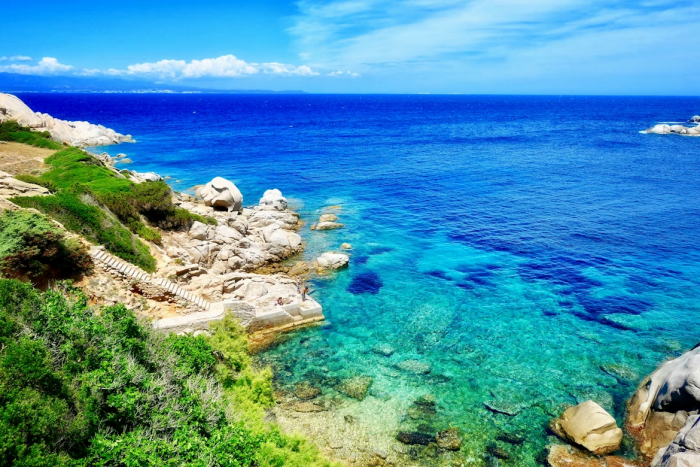
The geography itself does a lot of the work. Sardinia’s south is gentler than its dramatic east or its glittering northeast. The beaches here tend to slope shallowly out to sea, which matters more than it sounds. Young children can wade out a long way before the water reaches their waist. Parents can sit at the umbrella line and actually see them. Sailing lessons, paddleboards, snorkeling — they all become viable for a much wider age range when the water gives you room to make mistakes.
The food culture works in a family’s favor too. Sardinian cooking is, at its heart, simple and ingredient-led: bread, cheese, grilled fish, pasta with bottarga, the kind of cured meats and vegetables that even cautious eaters tend to accept. There is none of the formality that wears out small children in some Italian restaurants. Lunch on the south coast happens slowly, under shade, and nobody minds if your eleven-year-old wants pasta with butter for the third day running.
The pace, in general, is the point. Mediterranean slow life is a cliché until you’ve actually lived a week of it with your family, at which point it becomes a small revelation.
Why activity-rich resorts solve the teenager problem
Most parents discover, sooner or later, that a beach is not enough. A six-year-old will dig in the sand for hours. A fourteen-year-old will dig for about ninety seconds and then ask what’s next.
This is where a particular kind of resort — the ones built around dedicated programming for younger guests, like Forte Village on the southern coast — earns its place. The category isn’t new, but the better operators have moved a long way past the cliché of the bored kids’ club in a windowless room. What you find at the right resort is closer to a small village of activities, calibrated by age:
- For younger children, structured play and supervised swimming in safe, gated areas, plus the steady presence of staff who do this professionally rather than as an afterthought.
- For older children, sports — football coaching, tennis, sometimes proper sailing instruction with qualified coaches.
- For teenagers, the things teenagers actually want: somewhere they can hang out with other teenagers without their parents watching, organized activities they can opt into without losing face, and the freedom to disappear for the afternoon without anyone needing to drive them anywhere.
That last point is the one parents underestimate until they’ve experienced it. The hidden currency of a family holiday is independent time — for the kids, and equally for the adults. A resort with its own beach, its own restaurants, and its own programming gives a teenager genuine autonomy within a safe perimeter. The parents, in turn, get back the thing they were actually trying to find when they booked the trip: the chance to sit with a coffee, or a book, or each other, without managing anyone else’s day.
For families thinking about the broader Italian context — there are good reasons to consider Sardinia over the more familiar mainland choices — my notes on hotels in Rome cover the city-break alternative, though Rome and Sardinia tend to answer different questions about what a holiday should feel like. The official Sardegna Turismo site is a sober place to start for regional planning.
What it adds up to
A family vacation that works is, in the end, not a triumph of any single thing — not the food, not the beach, not the room. It’s a small infrastructure of decisions that quietly remove friction from a week that could otherwise unravel. South Sardinia provides much of that infrastructure naturally: the safe water, the unhurried rhythm, the food that suits a wide range of tastes. The resort tradition that has grown around it provides the rest. The two together explain why families who try this coast tend, quietly, to keep coming back.