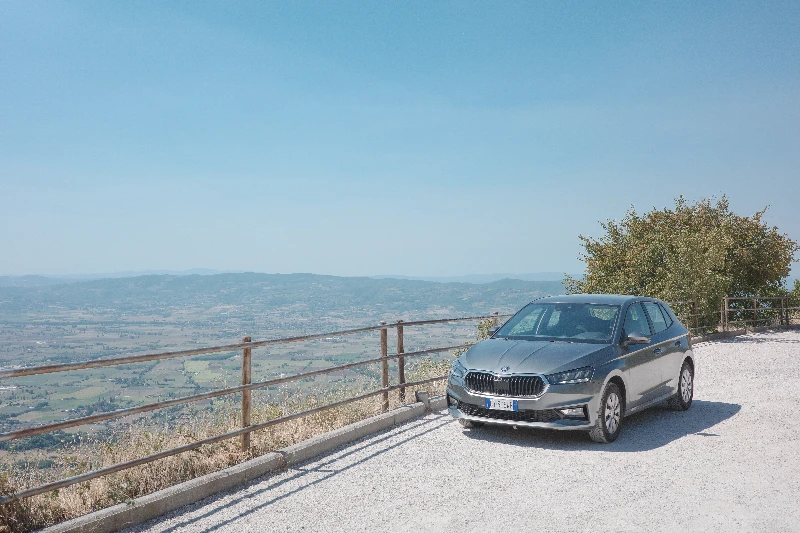
A car can feel perfectly comfortable on the way to work and somehow become a completely different vehicle after five hours on the highway.
The seat starts feeling less comfortable. Road noise gets annoying. You realize you brought way too much luggage. And that tiny cup holder you never thought about before? Suddenly, it is your biggest enemy.
Long-distance travel is simply a different test for a car. So, which type of car is actually best for a long road trip?
The short answer is: it depends. Let’s look at the main options and figure out which one might make sense for your next trip.
What Does the Ideal Travel Car Look Like?
Of course, every driver has their own idea of the perfect car. But when it comes to long-distance travel, there are a few things most people can agree on.
A good travel car should be comfortable and easy to drive for hours at a time. You want a seat you can actually sit in for half a day. You want enough room for your bags. And you probably do not want to arrive at your hotel feeling like you just finished a workout.
If we look at real-world models, the Toyota Camry and Highlander are good examples of different approaches to travel comfort. The Honda CR-V or Subaru Outback are also worth a look if you want a practical combination of space and versatility.
Nissan has some interesting options too. The Nissan Pathfinder, for example, gives travelers plenty of passenger and cargo space without going all the way up to a full-size SUV. If you want to compare the Pathfinder with other current Nissan models, take a look at https://www.oldorchardnissan.com/new-vehicles/.
But there is more than one way to build a good travel car. A sedan, SUV, minivan, or wagon can all work well, just for different reasons. So let’s break it down.
Sedans: The Easy Highway Companion
If your road trip usually means two people, a couple of bags, and hundreds of miles of highway, you might not need an SUV at all.
A good sedan can be a fantastic road-trip car. It is usually easy to drive, easy to park, and comfortable on long stretches of pavement. The lower driving position can also give the car a stable, planted feel on the highway.
And there is something nice about not driving more car than you actually need. If your luggage fits in the trunk and the back seat is mostly empty, why carry around a huge cargo area everywhere you go?
The problem starts when the packing list gets longer. Add three kids, five suitcases, camping equipment, or a couple of bicycles, and suddenly that spacious trunk does not look quite so spacious.
A sedan is a great choice if your idea of a road trip is mostly about comfortable highway miles and not carrying half your house with you.
SUVs and Crossovers: When You Need More Room
There is a reason SUVs and crossovers have become so popular with road-trip travelers. They offer a lot of space without necessarily feeling enormous.
For a family vacation, that extra room can be a lifesaver. Suitcases, backpacks, snacks, sports equipment, a stroller, and all those things you were sure you needed somehow have to go somewhere.
The higher seating position is another reason many drivers like SUVs. You get a different view of the road, and getting in and out can be easier.
All-wheel drive can also be useful if your trip includes snow, mountain roads, gravel, or other conditions where a little extra capability comes in handy.
But there is one thing worth remembering: More SUV does not always mean more comfort.
If you are traveling with one other person and two bags, a compact crossover may be more than enough. A three-row SUV starts making more sense when you actually have several passengers and plenty of stuff to carry. The trick is finding the size that matches your trip.
Minivans: The Family Road-Trip Hero Nobody Talks About
Let’s be honest. When someone says “dream road-trip car,” a minivan probably is not the first thing that comes to mind. But if you are traveling with children, give the minivan a chance.
Minivans are built around one very simple idea: getting people and their stuff from one place to another without making everyone miserable.
There is plenty of room inside. Seating is flexible. There is space for luggage. And then there are sliding doors. Sliding doors might not sound exciting until you try getting three kids out of a car in a crowded parking lot without hitting the vehicle next to you.
Suddenly, those doors are looking pretty impressive. For a family traveling several hundred miles, that kind of practicality can be more valuable than a rugged appearance.
A minivan may not look adventurous because it might just make your adventure easier.
What About Wagons, Hybrids, and EVs?
Not every traveler needs a sedan or SUV. A wagon can be a great middle ground. You get more cargo space than a traditional sedan without moving into a larger SUV. For someone who wants to pack generously but still likes the feel of a passenger car, it can be a very appealing combination.
Then there are hybrids. For long trips, they can make a lot of sense if you want to keep fuel stops to a reasonable number while still having the familiarity of a gasoline-powered vehicle.
EVs offer a different experience. They are quiet, smooth, and can be remarkably relaxing on the highway. The catch is that you need to think about charging before you leave. A route with plenty of convenient charging stations is a very different proposition from one where the next charger is hundreds of miles away.
And, of course, there are luxury vehicles. If your idea of a perfect road trip involves excellent seats, a quiet cabin, a smooth ride, and every comfort feature you can think of, a luxury sedan or SUV might be right up your alley.
Just remember that “more luxurious” and “better for your trip” are not always the same thing.
If you are carrying camping equipment for four people, a giant panoramic roof may be less useful than a few extra cubic feet of cargo space.
Bigger Isn’t Always Better
A love of big cars seems to be shared by almost every other traveler. And they will probably tell you something like: “My huge SUV is so comfortable!”
Not necessarily. A larger vehicle gives you more room, but comfort also comes from the seats, suspension, cabin noise, visibility, and driving position. A huge SUV is not automatically going to feel better after six hours than a well-designed sedan.
Consider two travelers. The first is taking a long weekend trip with a partner. They have two bags, mostly highway driving ahead of them, and no plans to leave the pavement. A comfortable sedan could be perfect.
Now imagine a family traveling across the country with three children, several suitcases, sports equipment, and a few outdoor stops planned along the way.
That same sedan might become a very questionable decision somewhere around the second suitcase.
Neither traveler has chosen the wrong car. They just have different ideas about what makes a trip comfortable. And that is really the point. You do not need the biggest vehicle. You need enough vehicle.
How to Choose the Right Car for Your Trip
Before choosing a car, think about your actual trip.
How many people are coming?
Two adults have very different space requirements from a family of five.
And if someone is going to spend six hours in the back seat, their opinion about legroom suddenly becomes very important.
How much are you taking?
A couple of weekend bags? Almost anything will work.
Camping gear, sports equipment, several suitcases, and enough snacks for everyone? You are going to appreciate having some extra cargo space.
Where are you going?
A highway trip through several states is different from a trip into the mountains.
If you are sticking to paved roads, comfort and efficiency may be your biggest priorities. If snow, gravel, or rough roads are involved, you may want more ground clearance or all-wheel drive.
How long are you driving?
This is an easy one to overlook.
A car can feel great for an hour. That does not necessarily mean it will feel great after six.
If you regularly take long road trips, pay attention to the things that become noticeable over time: seat support, cabin noise, visibility, ride quality, and how easy the car is to drive.
What usually annoys you?
This might actually be the most useful question.
Do you hate cramped seats? Look for more interior space.
Do you hate stopping for fuel? Consider efficiency.
Do you hate trying to squeeze luggage into a tiny trunk? Get more cargo room.
Do you hate parking a giant vehicle? Maybe you do not need that three-row SUV after all.
Sometimes choosing the right car is less about finding the one you love and more about avoiding the things that drive you crazy.
So, Which Type of Car Is Best for Long-Distance Travel?
So, which car should you actually choose? Well, it depends.
If it is just you and your partner with a couple of bags, a comfortable sedan might be all you need. Taking the kids, half the house, and enough luggage for a two-week vacation? An SUV or minivan will probably make your life much easier.
Maybe you travel light and care about fuel economy. In that case, a sedan, hybrid, or EV could be a better fit. Maybe you are heading somewhere with mountain roads and outdoor adventures waiting at the other end. Then an SUV starts to make a lot more sense.
And if your main goal is simply to be as comfortable as possible, there is nothing wrong with choosing something a little more luxurious.