Last updated on August 9th, 2026
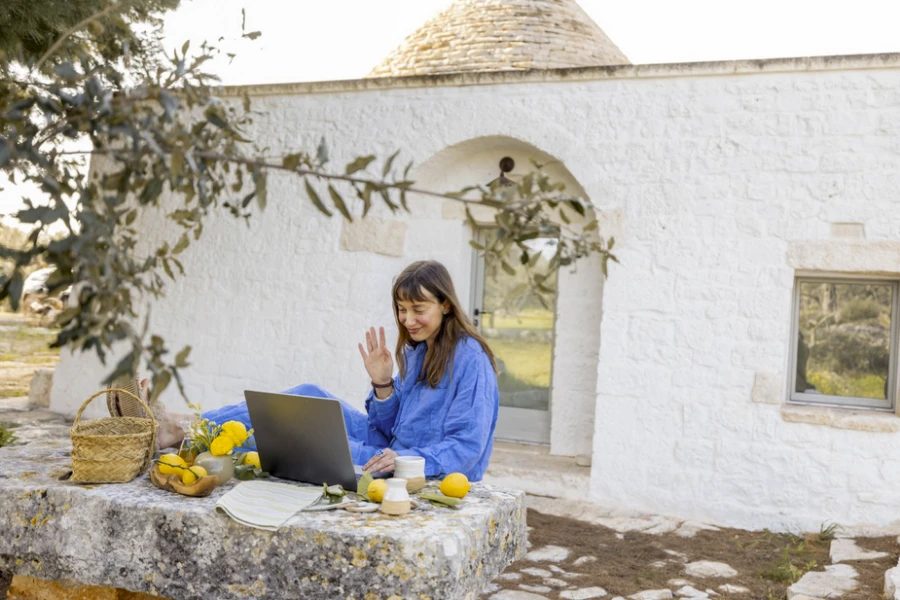
(https://www.freepik.com/premium-photo/video-call-from-nature_418160472.htm)
I was sitting in a notary’s office in Valencia, trying to sort out my NIE number, when I realised something that should have been obvious years earlier: the digital nomad lifestyle is not really about laptops and Wi-Fi. It’s about paperwork, landlords, and the person behind the pharmacy counter who doesn’t have time to mime your symptoms. And in the Mediterranean—where I’ve spent the better part of the last three years bouncing between Spain, Portugal, and the occasional detour to the Italian coast, the language that solves all of those problems is Spanish.
I say this as someone who showed up in Barcelona in 2021 with maybe forty words of Spanish and an optimistic assumption that English would carry me through. It didn’t. Not at the rental agency, not at the tax office, and definitely not at the neighbourhood bar where the Wi-Fi code was scribbled on a napkin I couldn’t read.
The Numbers Behind the Nomad Migration
Spain didn’t become the top destination for digital nomads by accident. It ranked first in the Global Digital Nomad Report 2025, beating out Portugal, Malta, and Germany for the top spot. Over 25,000 digital nomads have officially relocated there in the past three years, and those are just the ones with the visa stamp to prove it.
Globally, the tribe has grown fast. An estimated 40 million people were living as digital nomads by 2025—roughly double the figure from just a few years ago. In the US, the count went from 7.3 million in 2019 to 18.1 million in 2024. A hefty portion of that crowd is heading south toward the Mediterranean. And the ones who arrive without any Spanish tend to spend their first month solving problems that take ten minutes with even a basic grasp of the language.
What Spanish Actually Changed for Me
I’ll give you the practical rundown, because this is the stuff nobody puts in the glossy “live your dream life abroad” posts.
Spain’s digital nomad visa requires a minimum income of €2,646 per month. The application itself involves a stack of documents—proof of remote work, health insurance, background checks—and every step goes through Spanish bureaucracy. I watched fellow nomads in Facebook groups spend months going back and forth with gestures (administrative agents) because they couldn’t read the rejection letters. When I got mine, I handled most of it directly, and it took half the time.
Housing was the bigger win. The English-language rental market in cities like Málaga and Valencia is essentially a tourist surcharge with a twelve-month lease attached. The deals—the real ones, the ones locals find—are listed on Idealista and Fotocasa in Spanish, negotiated in Spanish, and signed in Spanish. Learning the language saved me about €300 a month on rent alone.
Then there’s the less tangible stuff. A 2024 Remote Workers Health Index study found that 89% of digital nomads in Spain reported reduced stress and improved well-being after just one month. I believe it. But I also think the ones who feel that way are the ones who can actually talk to their neighbours, order coffee without pointing, and laugh at a joke someone makes at the coworking space. Language is the difference between living somewhere and just being there.
If you’re thinking about making the move, my honest advice is to check your Spanish level before you book the flight. It gives you a benchmark, and more importantly, it shows you exactly where to focus so your first month abroad isn’t spent deciphering utility bills.
The Coworking Scene Runs on Two Languages
The coworking industry was valued at nearly $15 billion in 2024, with forecasts pushing it toward $40–46 billion by the end of the decade. Spain is at the centre of that growth. I’ve worked out of spaces in Valencia, Las Palmas, and Tarifa, and the pattern is the same everywhere: the morning crowd is international, the client calls are in English, and the lunch table is in Spanish.
The nomads who end up with the best local contacts, the freelance gigs that don’t come through Upwork, and the invitations to things that aren’t on Meetup.com—they’re the ones who can hold both conversations. I’ve picked up two long-term clients this way, both from casual Spanish-language chats that turned into real professional relationships. That doesn’t happen if you’re sitting in the corner waiting for someone to switch to English.
It Travels Further Than You Think
One of the things I didn’t expect is how far Spanish carries you outside Spain. The shared Latin roots with Italian, Portuguese, and French mean that once you have a decent base in Spanish, you can pick up enough of the other Romance languages to navigate your way around most of the Mediterranean. I spent two weeks in Sardinia last year and found myself reading Italian menus and road signs with surprising ease.
And if your nomad path eventually leads to Latin America—as it does for a growing number of remote workers chasing lower costs and warmer weather—you already have the language. No reset required.
The Bottom Line
I’ve been doing this long enough to know that the laptop-and-sunset Instagram version of nomad life is about 10% of the reality. The other 90% is logistics, relationships, and the thousand small interactions that make a place feel like home instead of a hotel. In the Mediterranean, Spanish is the key to all of it. You don’t need to be fluent before you go. But if you show up with nothing, you’ll feel the gap every single day.